Everything Speaks: Do You Have Negative Cues?
Everything Speaks: Do You have Negative Cues? Build your company’s Customer experience as if no Customer has bad intentions.
One of the biggest contributors to the Customer service crisis is management’s paranoia that Customers are out to take advantage of them. This leads to a significant amount of time that companies spend on creating and enforcing policy rather than creating positive Customer experiences. Why do so many companies’ agreements and policies sound so angry? You should be friendly to your Customers in every way you communicate with them.
Negative cues
Your Customers experience your brand in so many different ways. This includes not only the way your employees interact with your Customers but also all the messages being sent to them in countless ways. It is imperative that you take a step back and review any negative cues that are making your business appear less than world-class.
Negative cues are everywhere! They are messages that businesses create that have negative language, that warn Customers, and that are intended for 2 percent of their Customer base but end up insulting 100 percent. Negative cues come in many ways:
signage displayed inside our businesses and outside our buildings; on our websites; in contracts, agreements, and disclaimers; in spoken language and wording we use; in the physical actions of our employees and the way we dress; and anything that the
Customer can see or hear. Most of the time, you can say the same thing, but by rewording it you can make it sound like you are caring instead of threatening. Every interaction is a branding opportunity to articulate your genuine hospitality.
Verbal negative cues
Medical practices are the leaders in negative cues of all kinds. I checked in for a doctor’s appointment, and the receptionist said, “We need to verify your information.” “Verify” makes me feel like they don’t believe who I am, that maybe I am trying to use someone else’s insurance information. Simply saying, “May we update your information,” works much better and accomplishes the same. Another example is when a doctor sees a patient, and a nurse comes into the room during the exam and says, “Your ten thirty is here,” or “You have a call on line two.” At that point, the patient is convinced the doctor is now rushing and more concerned with the waiting patient. Some great medical practices have created verbal and nonverbal codes to inform the doctor without the patient realizing it.
When we started John Robert’s Spa in 1993, we immediately called our guests the day before to remind them of their appointments. To our surprise, some of our guests were offended by these calls because they felt we were insinuating that they were disorganized and did not keep track of their schedules. That is when we slightly changed wording from “reminding calls” to “confirmation calls.” We have never had a complaint about a confirmation call.
Don’t punish 100 percent of your Customers,
for what you are afraid 2 percent might try to do.
Signage
Signage has by far the highest occurrence of negative cues. I have taken so many pictures over the years of crazy negative signs I’ve come across. What businesses put on signs amazes me. Let’s start with the most common negative signage we all see too often: “We charge $20 for all returned checks” and “We are not responsible for lost or stolen merchandise.”
“Employees must wash hands before returning to work.”
The “Employees must wash hands” sign appears in the restrooms of restaurants that Customers use. This freaks me out, and I 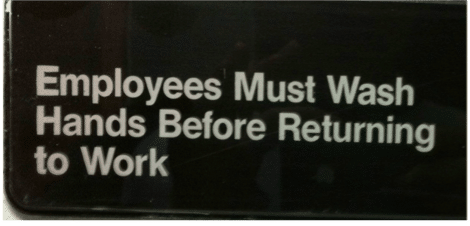 think they might not. I stopped at one fast food place, and before I ordered, I used their restroom, only to find that they had four of these signs up. One above the sink, one above the soap dispenser, one above the paper towel dispenser, and one on the inside of the door. This made me think that this establishment must have a real employee sanitation problem if they needed to decorate the entire bathroom with these signs. I chose to eat somewhere else. Now, I do understand that posting this sign is a requirement for most restaurants, but everything can be reworded. I saw a sign in a restaurant restroom that said it this way: “Cleanliness is important to us. We wash our hands before leaving.” This is so much better.
“We reserve the right to refuse service to anyone.”
Sadly, the message “We reserve the right to refuse service to anyone” is so popular that Amazon sells this sign! Someone sent me a picture of a sign that says “No English, No Service,” which was posted on the business’s door. Businesses must be really good at that place to blatantly discriminate.
Related: Do you have negative cues that you are unaware of?
Two distinctly opposite approaches to Customer service
On the register of one retailer, I read a sign that said, “We will not wait on you if you are on your cell phone while at the counter.” The business that displays this sign is frustrated and wants to teach their rude and inconsiderate Customers a lesson, thus making them ex-customers.
However, Brian Olson, owner of 45th Avenue Cleaners in Portland, Oregon, has taken a different approach to Customers on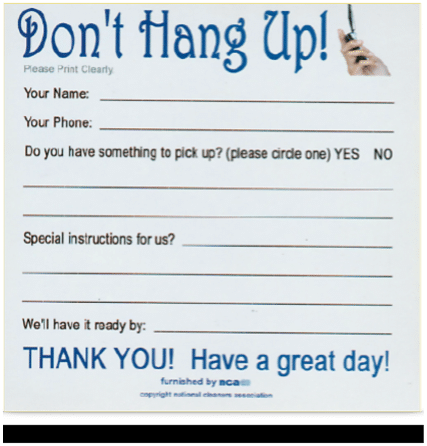 their cell phones. He displays a notepad on his counter that reads “Don’t Hang Up!”. He allows
people to drop off their clothes while conveniently jotting down their names and any special cleaning instructions without interrupting important calls. Customers on their cell phones are a fact of life today. He has found a way to put a positive spin on it.
Instead of punishing his Customers, he created a system that does not ruin their productivity while respecting and keeping the Customers happy and keeping them Customers!
Nine “Nos” on the door
I was speaking in Fort Worth, Texas, and stopped at one of those beautiful outdoor-lifestyle shopping centers with all the upscale retail stores. I walked by what appeared to be a high-end wine bar, which looked very fancy inside. However, when I got to the
door, I was shocked to see a sign on the door that listed nine things you could not be wearing, along with the recommended attire, to enter:
- no athletic pants, shirts, or shoes

- no hats
- no excessive jewelry
- no baggy clothes
- no T-Shirts
- no muscle shirts
- no ripped, torn, or frayed clothing
- business casual or business attire is suggested
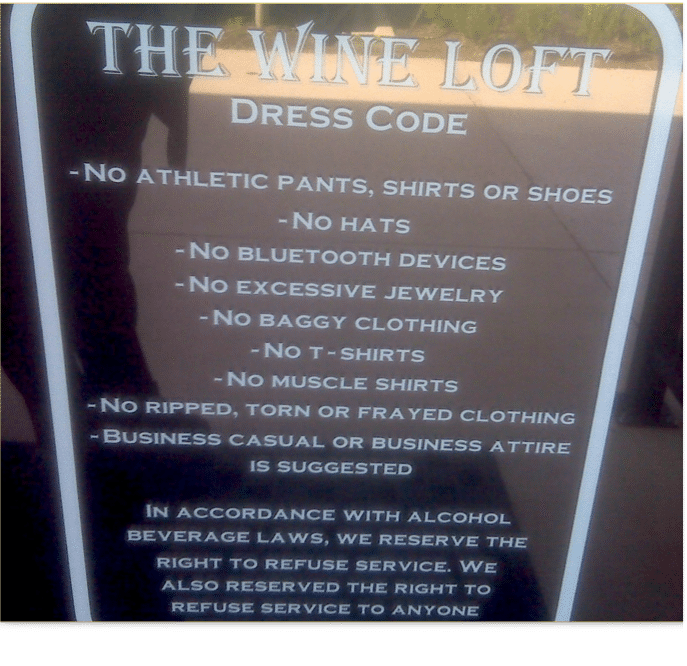
Wow! Considering the affluent area this shopping center was in; I am not sure what this business was worried about. All this business needed on the door was the last line: “Business casual or business attire is suggested.” By the way, I returned to the same
shopping center about a year later, and that space was vacant and for lease. Big shocker—I think the business owner was focused on the wrong things.
“Please wait to be seated.”
Typically, you see a sign at the entrance of many restaurants that reads, “Please wait to be seated.” However, once, I walked into a restaurant where I was startled to see a positive cue: “It would be our pleasure to seat you.” Just the slight tweaking of the message can dramatically impact the hospitable mood your business is setting for your Customer.
Related: Train your employees to deal with irrational customer rage
“Conditions of entry”
I spoke to a large group of business owners in Sydney, Australia, when a partner of one of the largest real estate companies approached me during a break. Just before the break, I shared my “negative cue” examples. The partner shamefully confessed that his company was guilty of some negative cues. When it holds an open house for potential buyers, it displays a sign on the front door of the house that reads “Conditions of entry,” and it proceeds to tell you that you cannot enter with food, drink, shoes, or unaccompanied children, along with a slew of other barriers to viewing the house. I was so excited when this gentleman showed me how he had already started rephrasing this sign on his notepad, which read, “Out of respect for the homeowner, we appreciate you removing your shoes . . .” He got it!
No Customers allowed past this point
The truck-repair service center of TravelCenters of America had a sign, “No drivers allowed past this point,” posted on the door that separated the area where the drivers waited from where their trucks were being serviced. While this policy was needed for insurance reasons, TravelCenters realized it needed to be stated better. It now says, “For your safety, if you need anything from your truck, one of our team members would be happy to assist you.”
Don’t even think about it

On a trip to beautiful Cape Cod, my family and I pulled into an antique store looking for a parking spot and noticed a vacant space right out front. As we got closer, we saw a sign at the front of that vacant space that read, “Don’t even think of parking here.” That sign also told me that was not a place I wanted to do business with.
What negative cues can you eliminate or change to make them more positive?
Many unnecessary rules, policies, and warnings do not need to punish the vast majority for what a small percentage may try to get away with. For the following items, think of ways you can protect yourself but say it differently:
- web site
- verbiage
- terminology
- signage
- what Customers see
- agreements
- employees’ actions.

Register now and Become a Zero-Risk Organization!
June 9, 2025 | 12:00 PM – 2:00 PM ET
- Identify and eliminate friction points in your customer journey
- Create a proactive service strategy that makes doing business with you effortless
- Learn how to prevent and recover from service failures in a way that builds customer loyalty
- Leave with a Zero Risk Action Plan to ensure every customer interaction is seamless and risk-free
The 2025 Livestream Workshop Series:
June 9: Become a Zero-Risk Organization
September 8: Create a Recruiting Experience
December 1: Create an Onboarding Experience
Create Non-negotiable Standards (This workshop has passed, but replay is available with full series purchase)
Are you ready to revolutionize how your organization delivers customer and employee experiences?
Join John DiJulius and Dave Murray of The DiJulius Group for the Experience Revolution Livestream Workshop Series.
This four-part series dives into essential strategies for creating a zero-risk organization, improving recruiting and onboarding experiences, and establishing non-negotiable service standards.
Reserve your spot today:
- Attend any workshop for $249 each
- Unlock the entire series, 4 workshops (plus 2 bonus replays!) for $749 *BEST VALUE*
Register Now and Save Your Spot
The Customer Service Revolution Podcast 
Ranked #1 Customer Service Podcast!
Subscribe today on itunes, spotify, YouTube, or wherever you listen to podcasts!
Podcast #199: Creating a Zero Risk Customer Experience
Looking for a Keynote Speaker?
Bring John in to your team or event!
Take advantage of special savings when John is in your area. See schedule below, or contact Claudia for details or to be alerted when John is in your area.

Now Enrolling!
Become a Certified Experience Executive in 2025

Transforming Leaders – Transforming Experiences – Transforming Cultures
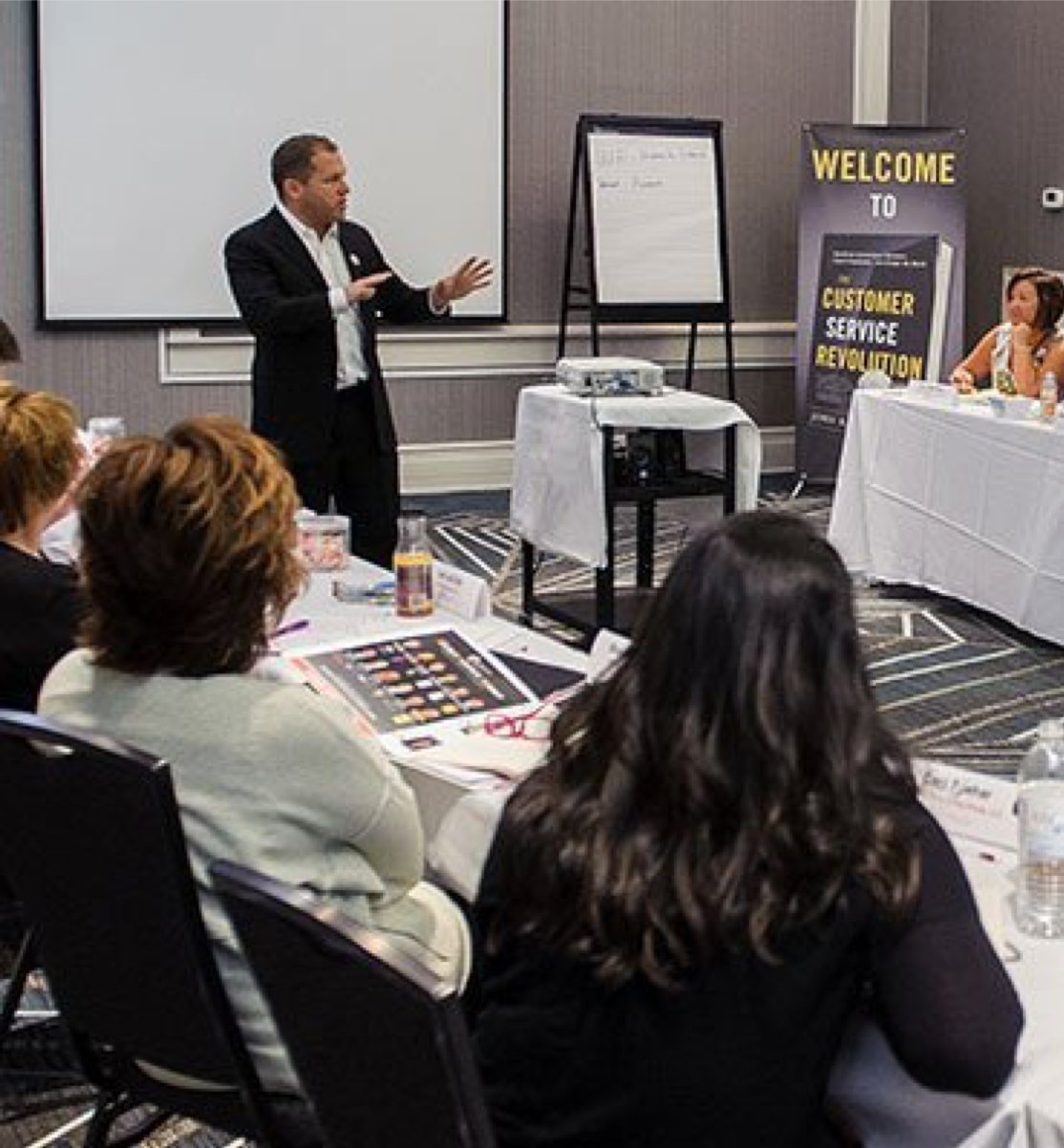
Our Experience Academy courses have been designed to certify people for a new level of leadership, benefiting their career and your organization.
- The Customer Experience Executive Academy enables you to assess an organization’s current state of service and work to build systems to consistently deliver world-class experiences.
- The Employee Experience Executive Academy enables you to assess your current culture and build systems to hire, onboard, train and retain the best employees.
Learn more about the CXEAcademy. Spring Session begins in April
Learn more about the EXEAcademy. Summer Session begins in June
Schedule a call to discuss registration
Become a More Confident Speaker, in Just 2 Days!
Join our June 10, 11 workshop in Cleveland, OH, led by John DiJulius and Dave Murray.
During this two-day workshop, you’ll learn to:
- Present with clarity and confidence
- Deliver messages that inspire action
- Connect with your audience every time