How to Create Your Brand’s Non-Negotiable Standards
Creating Your Brand Standards
World-class service companies have brand standards, or what I like to call a “Customer bill of rights,” that every person in that organization clearly knows and follows 100 percent of the time. Would you ever expect to see a Disney cast member, in full uniform on break, chewing tobacco and spitting on the ground near the front entrance where guests are walking by? Doubtful. Or would you ever think a Ritz-Carlton employee, when asked for directions to the ballroom, would give a response like “I don’t know, I work in housekeeping”? Highly unlikely! One of the most effective ways to elevate your company’s Customer service level is by instituting your own brand standards, The Customer Bill of Rights.
Customer Bill of Rights
If anyone is going to wear your uniform or name tag or represent your brand, you only need a small set (six to ten actions/standards) for your employees to live by. These non-negotiable standards are also referred to as the “never and always” list. The critical importance is, if they do occur, you must be confident enough that your employees recognize and understand your “never” and “always,” and you can be confident that your employees would “never” do this and “always” do that instead.
If your company does nothing other than institute the “never and always” list and makes everyone aware of them, if your Customers rarely experience a “never” and consistently experience an “always,” then you are in the top 5 percent of Customer service organizations! As you read through the list, you will see that they are all simple and common sense, but most businesses and frontline employees too often execute the “never” list and don’t consistently execute the “always” list.
In the examples shown, you will see that each one matches the following three criteria:
- The items are typically one to three words in length.
- They are black and white; there is no room for personal interpretation.
- They are crystal clear and do not need any additional explanation.
Some things you wouldn’t see on a “never and always” list are things such as “Always be professional” or “Always return calls promptly.” Why? Because they are vague. What is professional to one is completely different to someone else. What is “promptly”? To one person it may be two hours; to another it may be two days.
Related: Create Your Own Non-Negotiable Standards with Us March 10th
Do you want Customer loyalty? Be brilliant at the basics
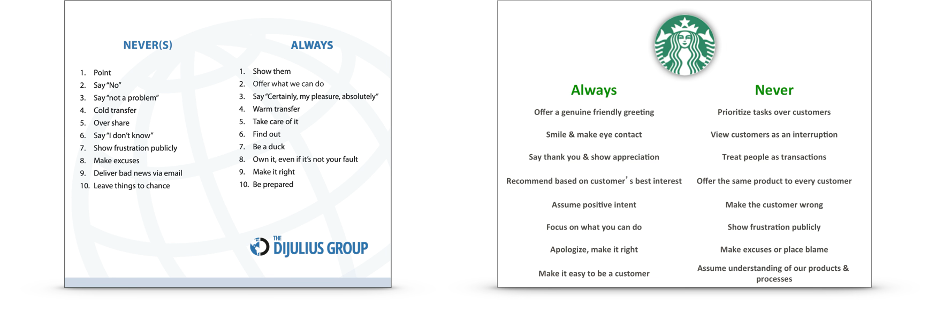
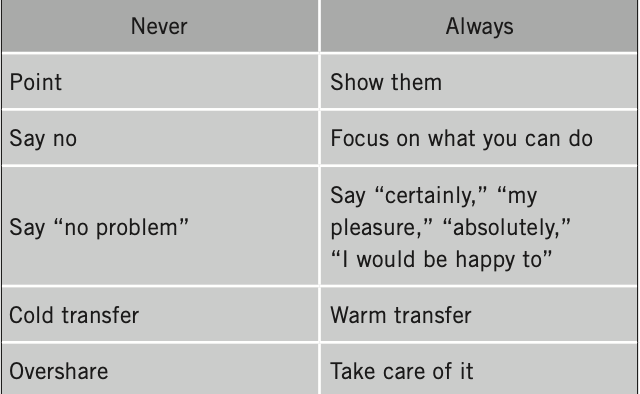
The following are great examples of “never” and “always” items that are a collection from several great companies, which The DiJulius Group had the pleasure to help to create. It is important to understand that these are not one company’s “never and always” list. Ideally, you only want a maximum of ten “nevers” and ten “always.” I have broken down the master list into small segments so I can share the logic behind them.
Brand Examples:
 Master List:
Point versus show
This is typically thought of in the hospitality business (e.g., showing someone to the restroom instead of pointing them there). However, in the business-to-business and call-center world, pointing happens all the time. For instance, it happens when we say things like “You can get that off our website” or “You need to call this person in this department.” Why are we making the Customer do the work? We can send them the link, and we can transfer them to the correct department.
Saying no versus focusing on what you can do
Eliminate the word no from your company’s vocabulary; no one should ever be allowed to use that word. You may not always be able to say yes, but offer alternatives and options and never allow anyone from your company to utter the word no. You will be amazed at how creative your team will get at satisfying Customers.
I never want a Customer of mine to tell me that someone from my organization said no to him or her. To me that is the worst swear word you can use in front of a Customer. While we cannot do everything our Customers request, we can always respond with what we can do. If someone asks if we can sell them something we don’t even sell, we can answer with “While we do not carry product X, what we do carry is product Z, and the reason we do carry product Z is because it is proven to be the best, longest lasting, healthiest, whatever.” By the time you are done explaining the benefits of product Z, that Customer should never want product X. If for some reason they still want product X, then you explain how and where they can get product X.
“No problem” is a big problem
The biggest street-slang terms used in every business today are the responses “no problem” or “not a problem.” In fact, because of reading this right now, you will be shocked at how many times you will hear “no problem” over the next two days. Joe Schumacker wrote an excellent blog titled “No Problem, Big Problem” that articulates this point well. “No problem” is a problem for two reasons. The first issue with saying “no problem” is that it consists of two negative words. We shouldn’t be using any negative words, let alone two back-to-back.
The second problem is that the “no problem” auto-response sends the message that what the Customer is asking of you is not a problem for you. However, when we are serving others, it is not about our convenience; it is about what the Customer wants. The phrase “no problem” places the staff member’s comfort ahead of service to the Customer. Customers want to feel that their interests are first and foremost in the mind of the staff member, not that they may have inconvenienced a staff member by being a Customer.
Excellent responses instead of “no problem” are “certainly,” “my pleasure,” “I would be happy to,” “consider it done,” and “absolutely.” Using “certainly” or “my pleasure” is so much more professional than the often heard “not a problem.” It elevates the professionalism of your employees’ terminology. It starts establishing a culture of hospitality where the Customer is first.
Cold transfer versus a warm transfer
Call twenty businesses today and ask to speak to someone, and nineteen times you will get a cold transfer—a receptionist who just transfers you to that person’s extension and that’s it. A warm transfer is when a Customer calls a business asking to speak to someone and the receptionist asks, “May I tell him who is calling?” Then she informs her coworker of the name of the Customer whom she is transferring. Her coworker picks up the phone and immediately says, “Hello, Susan, how are you?”
Overshare
Everyone loves to overshare. Why? Because they want to make sure the Customer knows it wasn’t their fault. “I didn’t know you were here.” “The receptionist never informed me.” “If I would have known, I would have been out sooner.” Or “Shipping didn’t next-day-air the package . . . I told them . . . I put it on the order . . .They do this type of stuff all the time.” Does the Customer really need to know who screwed up and why? All they need to know is how sorry we are about what happened, and here is what we are going to do about it. If we need to address something internally with other departments or coworkers, that’s our business. Our Customers do not need to know about our dirty laundry.
You should see how “never . . . point, say no, and say ‘no problem’” each match the three criteria:
(1) only one to three words in length,
(2) black and white, with no room for personal interpretation, and
(3) crystal clear and doesn’t need any additional explanation.
Brand Standard Examples
Do You Have Non-Negotiable Brand Standards?
If your team has not yet created your own unique brand standards or nevers always list, join us on March 10th. The DiJulius Group will be conducting a livestream workshop and we’ll help you get there. Our consultants will walk you through the steps to creating your own and then teach you the steps to implementation and training. Register today!

Make Customer and Employee Experience a Priority in 2025
Attend our Livestream Workshops!
March 10: Create Non-negotiable Standards
June 9: Become a Zero-Risk Organization
September 8: Create a Recruiting Experience
December 1: Create an Onboarding Experience
Are you ready to revolutionize how your organization delivers customer and employee experiences?
Join John DiJulius and Dave Murray of The DiJulius Group for the Experience Revolution Livestream Workshop Series.
This four-part series dives into essential strategies for creating a zero-risk organization, improving recruiting and onboarding experiences, and establishing non-negotiable service standards.
Reserve your spot today:
- Attend any workshop for $249 each
- Unlock the entire series, 4 workshops (plus 2 bonus replays!) for $749 *BEST VALUE*
Register Now and Save Your Spot
Now Enrolling!
Become a Certified Experience Executive in 2025

Transforming Leaders – Transforming Experiences – Transforming Cultures
Our Experience Academy courses have been designed to certify people for a new level of leadership, benefiting their career and your organization.
- The Customer Experience Executive Academy enables you to assess an organization’s current state of service and work to build systems to consistently deliver world-class experiences.
- The Employee Experience Executive Academy enables you to assess your current culture and build systems to hire, onboard, train and retain the best employees.
Learn more about the CXEAcademy
Learn more about the EXEAcademy
Schedule a call to discuss registration
Become a More Confident Speaker, in Just 2 Days!
Join our June 10, 11 workshop in Cleveland, OH, led by John DiJulius and Dave Murray.
During this two-day workshop, you’ll learn to:
- Present with clarity and confidence
- Deliver messages that inspire action
- Connect with your audience every time
Learn more about Presentation Skills Workshop
Looking for a Keynote Speaker?
Bring John in to your team or event!
Take advantage of special savings when John is in your area. See schedule below, or contact Claudia for details or to be alerted when John is in your area.