5 Customer Experience Strategies for 2026
One constant I have heard repeatedly this past year is that customers’ expectations have never been higher. I totally disagree. I believe customers are less tolerant of poor service and are more willing to voice their frustration and switch brands faster than ever. Customers are tired of the customer service recession. They have had to deal with shrinkflation, trickflation, tipflation, tarifflation, and inflation has caused the experience gap, where customers are paying more and getting less.
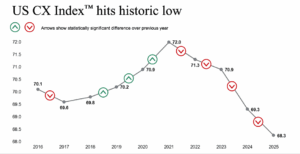
A Forrester study has revealed that CX quality in the US and Canada is at an all-time low, and it is continuing to erode year after year.
*Related – Learning To Recognize And Navigate The Customer Service Recession
Weaponize Customer Service Recession
A recent study found that 66 percent of consumers are ready to walk if a brand breaks a promise. When the CX bar is so low that it is, that is when brands can truly stand out and make the experience, they deliver their most significant competitive advantage. According to a Wall Street Journal report, 86% of the 800 C-suite members surveyed expect CX to become a top-tier investment priority.
The following are five customer experience strategies we recommend for companies to focus on to become the brand customers cannot live without, making price irrelevant.
*Related – The Experience Revolution Livestream Quarterly Workshops
1. Hire and train for Service Aptitude Skills
A key reason why CX quality among brands has plummeted to an all-time low is due to the lack of soft skills among customer-facing employees. We live in the “digital disruption era,” where technology has brought unprecedented advances in information, knowledge, instant access, and entertainment. However, as convenient as these advances make our lives, they have also changed how we communicate, behave, and think, dramatically declining our people skills.
Relationship Disadvantaged
As a society, we are now relationship disadvantaged. We no longer become curious about others or eager to engage in conversations. We spend less time with friends via in-person interactions. The younger generation primarily communicates electronically, and the explosion of e-commerce means we go out less and less. When we do, we now have the option of self-service checkout to avoid interacting with other human beings. A simple interaction can have profound effects on someone’s emotional well-being.
While these skills seem like basic expectations of individuals in the workforce, one study showed that nearly 60% of leaders in the U.S. believe it’s challenging to find candidates with soft skills. That is why it is the responsibility of companies and the training they provide to continually develop these skills.
Not all service aptitude skills can improve with training
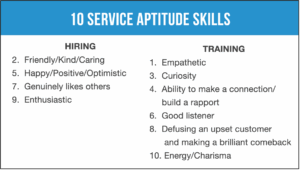
Four of the ten service aptitude skills cannot be significantly improved even with extensive training. Those four need to be screened for in your interview & hiring process; the rest can be improved through employee training.
*Related – How to train our employees on service aptitude skills
Hire for the Heart, Train for the Part
All the training in the world will not make a significant improvement in a person who doesn’t enjoy others. The same applies if you encounter people who are negative and generally unhappy. Your goal is to find candidates who have exceptional service aptitude and are happy, kind, caring, friendly, positive, optimistic, grateful, and genuinely like others.

This guide is the best resource for the Interview Question Guide to Gauge Service Aptitude. This guide focuses on whether candidates have the potential to deliver excellent customer experience skills, primarily in the form of soft skills. These questions should be combined with other interview questions not listed in our Guide that assess skills such as technical knowledge, work ethic, and cultural fit. We also do not recommend using all these questions; pick the ones that best fit your company’s customer service culture.
*Related – Customer Experience Executive Academy
2. Microlearning
Long gone are the days of having employees sit in front of a screen and watch hours of talking heads, training videos, or read training manuals. This is not just a generational trend. The way employees learn, retain, and consume information has undergone significant evolution. Whether you are launching or maintaining top-of-mind awareness (TOMA), your employees need to be aware of your Customer Experience Action Statement & pillars, Never & Always standards, Signature Customer Experience, or Zero Risk protocols. How you do it is critical.
Microlearning is the hottest trend in professional development today. Microlearning is an educational approach that delivers content in short, focused segments, typically lasting less than 5 minutes (think TikTok, YouTube shorts, or IG reels). These concise learning units are designed to address specific training, making them easily digestible and accessible at the learner’s convenience. See the two CX training reels below (both less than a minute long).
*Related – The Most Effective Way To Train Gen Z On Customer Service
3. The Single Most Important KPI To Track For Customer Experience
Survey Fatigue
Businesses that only measure Net Promoter Score (NPS) or Customer Satisfaction (CSAT) survey results are falling significantly behind. Today, customers have survey fatigue. Customer surveys are a dinosaur and broken. As I write this blog, I have six surveys sitting in my email inbox and three other surveys sitting in my text messages, none of which I will respond to, from brands asking me to share my feedback on my recent experience. Today, survey response rates have never been lower.
The problem with NPS is that it asks the question, “How likely are you to recommend us?” The challenge with that question is that you are trying to measure the customer’s intent. I don’t care about their intentions; I care about their action. Did they actually refer us?
Do you know the Difference Between Bought Sales vs. Earned Sales?
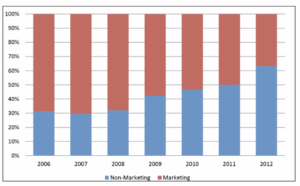
The two most undervalued metrics business leaders can track, obsess over, and build awareness around are customer retention and customer referrals. The best measure of a brand’s customer experience is Earned Sales Growth. ESG measures recurring revenue—the revenue growth generated by returning loyal customers and their referrals. Your revenue comes from two places: 1) Bought sales (advertising) and 2) Earned Sales (repeat and referrals).
Earned Sales Growth Case Study
The following represents a law firm’s earned sales growth over the past seven years. You can see that in the first few years, they had an ESG of 30%, meaning that 70% of their new clients came from advertising (i.e., bought sales). Which, believe it or not, is an excellent ESG for injury attorneys. However, as the firm became client-obsessed, its ESG grew to nearly 65% by year seven. This is a massive decrease in advertising dollars. ESG is significantly more profitable.
4. Your EX = Your CX
Great Employee Morale Survey Question
I love the following question to measure employee morale:
- On a scale of 1-10 (10 being the best), how do you feel on Friday at 6 pm?
- On a scale of 1-10 (10 being the best), how do you feel on Sunday at 6 pm?
Obviously, it is unrealistic to assume that most people’s excitement on a Sunday night will be as high as it is on a Friday night (assuming they have the weekend off). However, this gives you an excellent baseline for moving the needle on Sunday night. The most common answer I get to the question of how you feel on a Friday night is an eight or higher, and less than 3 on a Sunday night. I know people who have told me they start to get a not in their stomach around Sunday night, realizing their weekend is over, and dread Monday mornings.
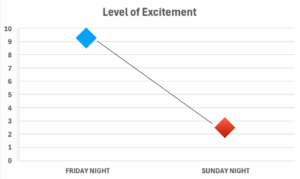
What if your employees averaged 6, 7, or 8 on Sunday night? You would be an outlier. Your morale would be incredibly high, and your turnover would be extremely low. Every leader’s goal should be to build a culture where people are excited about the work they do.
“As leaders, we need to build the type of company that helps employees be
proud of the work they do and have an opportunity to live their best lives.”
Constant Professional Development
Too often, the majority of an employee’s training happens in their first few years with an organization. According to LinkedIn’s Workforce Learning Report, 94 percent of employees say that they would stay at a company longer if it simply invested in helping them learn.
This interest in learning and development is particularly strong among younger workers. LinkedIn’s research found that roughly a quarter of Gen Zers and millennials say learning is the number one thing that makes them happy at work. Over a quarter (27 percent) of Gen Zers and millennials say the number one reason they’d leave their job is that they did not have the opportunity to learn and grow.
*Related – The Employee Experience Revolution Book
Recognize, Recognize, and Then Recognize Some More
Did you know that 63 percent of employees who are recognized regularly said they wouldn’t consider looking for a new job? Our loved ones and coworkers are not telepathic about our appreciation: You must continually express your gratitude and appreciation.
5. AI + Human Experience
The AI revolution is reshaping how organizations approach customer experience. Leaders are rushing to automate more, cut labor costs, and reduce customer-facing roles—but in doing so, they risk losing the human touch that drives customer loyalty. Most current AI tools focus on efficiency—such as summaries, search, and automation—while overlooking the emotional connection that customers crave. AI excels at making business easier, but humans still create the experience customers remember.
Today’s AI can suggest responses, recap past interactions, flag follow-ups, and resolve routine issues. This frees human agents to do what machines can’t: solve complex problems with empathy. The future belongs to organizations that use AI to enhance—not replace—the human side of service, helping employees respond more quickly, naturally, and with genuine emotional intelligence.
*Related – The Customer Service Revolution Podcast
It’s essential to remember that AI is not intended to replace human agents, but rather to enhance the customer service journey. By combining AI with human expertise, businesses can offer exceptional experiences that foster loyalty. Here are five practical ways your company can leverage AI to implement the X Commandment Methodology:
- Personalization at Scale
Customers crave connection. But personalizing every interaction across thousands—or millions—of touchpoints feels impossible.
- AI can analyze data from previous purchases, preferences, and behaviors to recommend the “next best action” for employees in real time.
- An example of this is when a frontline rep is prompted to recognize a customer’s loyalty milestone, or a system generates a tailored follow-up email that feels handwritten.
- Recruiting and Onboarding Experience
We teach leaders that the employee experience drives the customer experience. AI can transform your recruiting and onboarding process.
- AI-driven applicant screening highlights candidates who align with your company’s service culture—not just their resume.
- Personalized onboarding bots guide new hires through their first 90 days, reinforcing your customer experience commandments.
- Predictive Service Recovery
The best service recovery happens before the customer even complains.
- AI can flag at-risk customers by identifying changes in buying patterns or sentiment in support tickets.
- Your team can proactively reach out with a thoughtful, human-led interaction—showing you truly care before frustration escalates.
- Coaching & Training Reinforcement
Leaders know training isn’t a one-and-done event. AI can ensure your employees retain and apply what they learn.
- Micro-learning nudges remind team members of the key commandments throughout their day.
- AI chat coaches answer “in the moment” service questions, reinforcing what we teach in workshops.
- Measuring What Really Matters
Many companies measure lagging indicators (such as sales and retention) but fail to capture real-time customer sentiment.
- AI-powered text and voice analytics reveal emotional cues during calls, chats, or reviews.
- Leaders can spot trends, celebrate wins, and coach teams precisely, building a service culture that compounds.
The Human Touch Still Wins
By combining AI and human expertise, businesses can create more meaningful, engaging interactions that resonate with customers. Brands must strike a balance between automation and the right amount of human expertise.
Ready to future-proof your customer experience? Let’s talk about how these strategies can drive loyalty, differentiation, and growth in 2026 and beyond.
Schedule your FREE Call!
________________________________________________________________________________________